PROXIMANOVA-LIGHT.OTF PROXIMANOVA-LIGHTIT.OTF PROXIMANOVA-EXTRABLD.OTF PROXIMANOVA-BOLD.OTFPROXIMANOVA-BLACK.OTF
Get this font in here!
This Article Applies to:
- Avast Business CloudCare
IMPORTANT: The CloudCare console does not support opening multiple tabs in the same browser session. Please use multiple browsers or incognito mode instead.
UPDATE: As of 19 October 2026, two-factor authentication (2FA) is required for all CloudCare partner, self-managed, and distributor users. As part of this enforcement, 2FA was reset for all users, so you must complete a new setup the next time you log in, even if you previously had 2FA enabled.
This is expected behavior and does not indicate an issue with your account. The new setup uses an updated MFA solution with improved security, so your previous 2FA enrollment cannot be reused.
Thank you for your cooperation in completing this security update. Please contact us if you need assistance.
Behavior Shield is an additional layer of Antivirus active protection. It monitors all processes on the device in real time for suspicious behavior that may indicate the presence of malicious code. Behavior Shield works by detecting and blocking suspicious files based on their similarity to other known threats, even if the files are not yet added to the virus definitions database.
Behavior Shield is available for Windows workstations only.
Configuring Behavior Shield Settings
To access
- Go to the Policies page (at partner level for master policies or customer level for customer policies)
- Select the desired policy from the left-hand pane
- Under Endpoint Protection, expand the Antivirus section
- Go to the
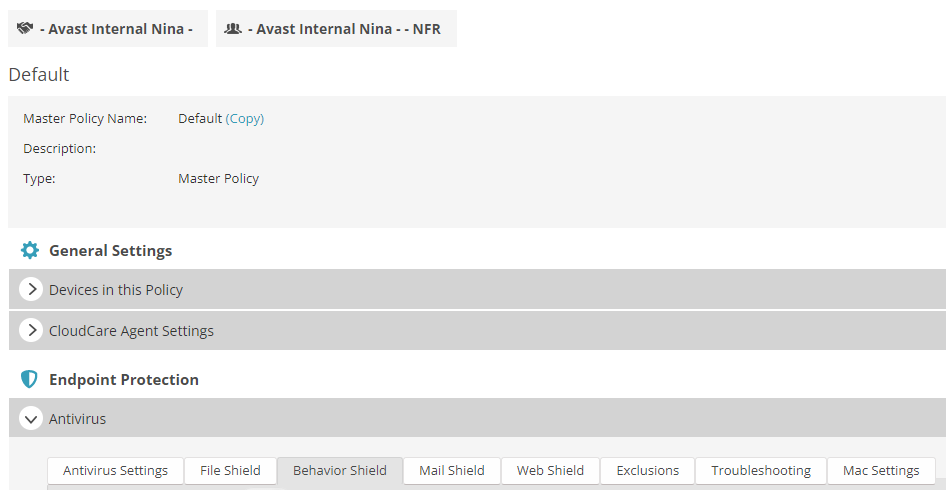
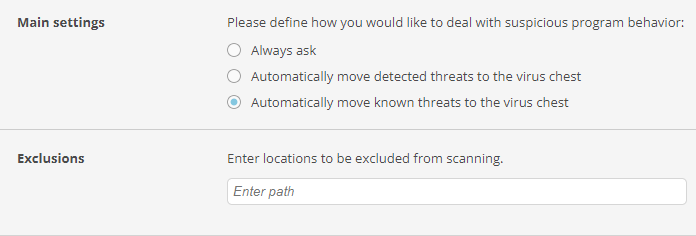
The available configuration options are grouped as follows:
- Main Settings define which action the shield should perform upon detecting a suspicious program:
- Always ask: Behavior Shield asks what you want to do with a detected threat before any action is taken.
- Automatically move detected threats to the virus chest: Threats that behave similarly to known threats listed on the Avast virus definitions database are moved to Quarantine.
- Automatically move known threats to the virus chest (enabled by default): Threats that are listed on the Avast virus definitions database are moved to Quarantine, unknown threats will be asked.
- Exclusions allow specifying locations that should be excluded from Behavior Shield scans.
For more information on standard and component-specific exclusions, see
FAQ
 Why can't I disable Behavior Shield individually in a managed Antivirus client?
The managed endpoints are designed to be controlled from the policies, therefore the important shields are inaccessible from the UI to be disabled individually. Core Shields can only be disabled together.
Why are the Core Shields options/Behavior Shield Geek Area values blank, usually in managed devices?
The local Antivirus is simplified with its controls in the UI. The user can only control all shield settings from these toggles at once, rather than individual settings for each shield.
We have the advanced controls in our managed policies to be able to configure each shield individually, which overwrites the local client settings, leading to these options being empty. The same can be performed from the Geek Area.
They are still configured correctly, they simply are not visible in the local client UI.
How do I stop the user from disabling Behavior Shield?
Enable password protection of the UI to prevent the local user disabling shields.
Application is not able to run with Behavior Shield enabled, what can I do?
Add the application as an exclusion either in the global or Behavior Shield specific exclusions. Verify if there are any potentially conflicting applications (e.g. another antivirus) running on the system and remove it if found.
Other Articles In This Section:
Related Articles: